Quick Answer
For dry and sensitive skin, the best facial cleanser is usually a gentle, low-irritation formula that removes sunscreen, oil, and light makeup without leaving skin tight, stinging, or stripped. In practical terms, the best overall choice for most buyers is a fragrance-free, non-exfoliating, non-foaming or low-foaming cleanser with humectants and barrier-supportive ingredients, because that profile tends to balance cleansing power with skin comfort.
That said, the right alternative depends on your skin’s specific triggers. A cream or lotion cleanser is often better for very dry, reactive, or mature skin. A micellar or milk-style cleanser can suit people who dislike rinsing. A gentle gel cleanser may work better if you have dry skin but still deal with sunscreen buildup or occasional congestion.
The biggest limitation of this guide is scope: this article is a buying guide, not a ranking of every cleanser sold worldwide, and it does not claim independent hands-on or laboratory testing. The goal is to help you choose the right type of facial cleanser for dry and sensitive skin based on documented buying criteria.
Products Included in This Comparison
Because the topic provided is a facial cleanser buying guide rather than a fixed list of exact cleanser models, this article evaluates the main cleanser types commonly considered by buyers with dry and sensitive skin:
- Cream cleanser
- Lotion cleanser
- Milk cleanser
- Micellar cleanser
- Gentle gel cleanser
- Cleansing balm
- Oil cleanser
- Foaming cleanser
- Exfoliating cleanser
This is a category-limited comparison of cleanser types, not a ranked list of every individual facial cleanser product on the market.
How We Evaluated the Products
This is a documentation-based editorial assessment designed to help consumers choose a facial cleanser for dry and sensitive skin. It does not assume hands-on testing or laboratory analysis by Olive Branch.
The ranking framework focuses on what matters most for this skin type:
- Likelihood of cleansing without disrupting the skin barrier
- Risk of irritation from common triggers such as fragrance, harsh surfactants, acids, and scrubbing particles
- Ability to rinse or wipe away comfortably
- Suitability for daily use
- Compatibility with sunscreen, light makeup, and seasonal dryness
- Simplicity of use for people managing irritation-prone skin
Different evidence types should be treated differently:
- Official information: ingredient lists, product claims, usage directions, and brand descriptions
- Independent evidence: dermatologist guidance, established skin-care references, and broader ingredient knowledge
- Public user feedback: recurring reports such as tightness, residue, stinging, or comfort, when those patterns are commonly discussed across multiple retail and editorial platforms
Brand popularity, packaging style, and trendiness are not the basis for the ranking. The central question is simple: what type of gentle facial cleanser is most likely to work well for someone with dry and sensitive skin while minimizing avoidable irritation.
Comparison Table
| Product Type | Best For | Key Strength | Main Limitation | Evidence Confidence | Editorial Position |
|---|---|---|---|---|---|
| Cream cleanser | Most dry, sensitive skin types | Cleanses with low stripping risk | May feel too rich for some | High | Best Overall |
| Lotion cleanser | Very dry or compromised skin | Extra comfort, minimal foam | Can leave residue or feel less “clean” | High | Best for Very Dry Skin |
| Gentle gel cleanser | Dry skin that still wants a rinse-clean feel | Better at removing daily buildup | Some formulas are still too surfactant-heavy | Medium to high | Best Balanced Alternative |
| Milk cleanser | Reactive skin that dislikes strong cleansing | Soft texture, usually mild feel | Not always strong enough for heavy sunscreen or makeup | Medium | Best for Reactive Skin |
| Micellar cleanser | Minimal-rinse routines, morning cleansing | Convenient and usually simple | Some people react if residue is left on skin | Medium | Best for Convenience |
| Cleansing balm | Makeup and sunscreen removal | Effective first cleanse with less tugging | May need a second cleanse and can feel heavy | Medium | Best for Makeup Removal |
| Oil cleanser | Dry skin needing sunscreen breakdown | Good slip, less friction | Formula quality varies widely | Medium | Best First-Cleanse Option |
| Foaming cleanser | Buyers who strongly prefer foam | Can feel fresher than cream types | Often more drying for this skin type | Medium | Usually Not the First Choice |
| Exfoliating cleanser | Occasional smoothing concerns | Can combine cleansing and resurfacing | Higher irritation risk | Medium | Lowest Priority for Sensitive Dry Skin |
Ranked Recommendations
1. Cream Cleanser — Best Overall
A cream cleanser ranks first because it usually offers the strongest overall balance for dry and sensitive skin. This cleanser type tends to remove daily grime without relying on aggressive foaming action, and it is often easier to formulate with moisturizing and soothing ingredients.
Core strengths include:
- Lower likelihood of leaving skin tight after washing
- Usually better comfort during cold weather or low-humidity months
- Good fit for daily cleansing, especially once or twice a day
- Often easier to pair with retinoids, acne treatments, or exfoliants that already increase dryness
Why it earned the top position:
Cream cleansers match what most people with dry and sensitive skin actually need: enough cleansing to remove normal buildup, but not so much that cleansing itself becomes the cause of redness, flaking, or burning.
Important limitations:
- Some cream cleansers are too light to fully remove water-resistant sunscreen or heavier makeup on their own
- A few can leave a film that some users dislike
- “Cream” on the label does not guarantee a gentle formula; fragrance and active exfoliants can still be present
Best suited to:
- Dry skin
- Sensitive skin
- Mature skin
- Skin using prescription or over-the-counter actives
- People who often feel tightness after washing
Less suitable for:
- People who want a very squeaky-clean finish
- Very oily skin types
- Anyone routinely wearing long-wear makeup without double cleansing
Evidence limitations:
The category is broadly well supported by common dermatology guidance, but individual formulas vary widely. Buyers still need to check ingredients rather than relying on texture alone.
2. Lotion Cleanser — Best for Very Dry Skin
Lotion cleansers are often even gentler-feeling than cream cleansers and can be especially helpful when the skin barrier feels fragile, irritated, or overtreated. They usually prioritize comfort over deep cleansing.
Core strengths include:
- Very low-foam, low-friction cleansing
- Often the most comfortable style for skin prone to burning or stinging
- Strong option for morning cleansing or non-makeup days
- Useful during winter, eczema-prone periods, or after over-exfoliation
Why it earned this position:
For very dry skin, a lotion cleanser may be the easiest type to tolerate consistently. If your face reacts to “regular” cleansers, a lotion formula can be a practical next step.
Important limitations:
- May not remove sunscreen or makeup well enough as a one-step cleanser
- Some users dislike the richer feel
- Can create the impression that skin is not fully cleansed, even when it is appropriately clean for a gentle routine
Best suited to:
- Very dry skin
- Compromised skin barrier
- Mature or fragile skin
- Minimalist skin-care routines
Less suitable for:
- Heavy sunscreen or makeup wearers
- People who strongly prefer a fresh-rinsed finish
- Anyone with congestion concerns who needs stronger cleansing
Evidence limitations:
The benefit is mostly based on cleanser behavior and formulation style. Effectiveness depends heavily on the specific surfactant system and whether the product is fragrance-free.
3. Gentle Gel Cleanser — Best Balanced Alternative
A gentle gel cleanser is the best alternative for people who have dry and sensitive skin but still want a more traditional cleanse. This type can work well if you wear sunscreen daily, live in a humid climate, or dislike creamier textures.
Core strengths include:
- Better rinse-clean feel than many cream or lotion cleansers
- Often more effective on daily sunscreen and oil
- Easier transition for buyers moving away from harsher cleansers
- Can suit combination skin that is dry in places but not uniformly dry
Why it earned this position:
Many shoppers searching for a cleanser for dry sensitive skin still want something that feels like a “real wash.” A gentle gel can meet that preference without the higher drying risk of many foaming formulas.
Important limitations:
- “Gentle” is not a regulated term; some gel cleansers are still too strong
- A formula can be clear and lightweight yet contain irritants like fragrance, essential oils, or strong acids
- Overuse, especially with hot water, can still dry the skin
Best suited to:
- Dry-combination skin
- Daily sunscreen wearers
- People who dislike creamy residue
- Buyers who want one cleanser for year-round use
Less suitable for:
- Extremely dry, cracked, or reactive skin during flare-ups
- People highly sensitive to any rinse-off surfactants
- Users seeking the softest possible cleanse
Evidence limitations:
This category has more variation than cream or lotion cleansers, so ingredient review is especially important before buying.
4. Milk Cleanser — Best for Reactive Skin
Milk cleansers are often chosen for their soft texture and mild cleansing style. They can be an excellent fit for reactive skin that becomes red easily or stings with many standard cleansers.
Core strengths include:
- Comfortable, low-aggression cleansing experience
- Often less drying than foaming options
- Good for morning cleansing or a gentle second cleanse
- Can reduce the temptation to over-cleanse
Why it earned this position:
For people whose main goal is avoiding irritation, milk cleansers often make sense. They are not always the most thorough cleansers, but they can be among the most comfortable.
Important limitations:
- May struggle with long-wear sunscreen, makeup, or oily buildup
- Texture preferences are highly personal
- Some formulas market themselves as soothing while still including fragrance
Best suited to:
- Reactive, redness-prone skin
- Morning cleansing
- Light cleansing routines
- People who want a soft, non-stripping feel
Less suitable for:
- Heavy makeup users
- People who want one cleanser to do everything
- Skin that needs stronger cleansing at night
Evidence limitations:
The category’s gentleness is often real, but performance can be inconsistent across products.
5. Micellar Cleanser — Best for Convenience
Micellar cleansers can work well for dry and sensitive skin when used thoughtfully, especially for morning cleansing, travel, or situations where a full sink wash is inconvenient.
Core strengths include:
- Convenient and easy to use
- Usually low-foam
- Helpful for people who cannot tolerate vigorous rinsing
- Can be useful as a light first cleanse
Why it earned this position:
Convenience matters. If a product is simple enough that you use it consistently without irritating your skin, that has real value.
Important limitations:
- Not all micellar products feel residue-free
- Some sensitive users prefer to rinse after use, which reduces the convenience advantage
- Cotton-pad application can add friction if used aggressively
- Makeup-removal strength varies a lot
Best suited to:
- Morning cleansing
- Travel
- Minimal routines
- People who want a quick cleanse without a full wash
Less suitable for:
- Heavy sunscreen or makeup removal
- People who dislike leave-on residue
- Highly reactive skin that responds poorly to surfactant residue
Evidence limitations:
Public user feedback commonly differs on whether rinsing is necessary, so user preference and tolerance matter more here than in some other cleanser categories.
6. Cleansing Balm — Best for Makeup Removal
Cleansing balms are often a strong choice as a first cleanse for dry and sensitive skin, especially when makeup or water-resistant sunscreen is involved. The main advantage is effective breakdown with less rubbing.
Core strengths include:
- Removes makeup and sunscreen efficiently
- Can reduce mechanical tugging compared with wipes
- Often leaves skin more comfortable than harsh makeup removers
Why it earned this position:
A balm can solve a common problem for dry skin: the need to remove stubborn products without scrubbing. Used as step one, it can make the rest of the routine gentler.
Important limitations:
- Usually better as part of double cleansing than as the only cleanser
- Some balm formulas are fragranced
- Residue or eye sensitivity can be an issue for some users
- Jar packaging may be less convenient for certain buyers
Best suited to:
- Daily sunscreen users
- Makeup wearers
- Anyone replacing makeup wipes
- Dry skin that gets irritated by scrubbing
Less suitable for:
- Very minimalist one-step routines
- People who dislike richer textures
- Users prone to reacting to fragranced cleansing products
Evidence limitations:
The category is effective in principle, but sensitive-skin suitability depends heavily on the specific formula and fragrance profile.
7. Oil Cleanser — Best First-Cleanse Option
Oil cleansers can be excellent for dry skin because they dissolve sunscreen, sebum, and makeup with less friction than many traditional cleansers. For sensitive skin, though, formula differences matter a lot.
Core strengths include:
- Strong at dissolving oil-based debris
- Can feel gentler than repeated foaming cleanses
- Useful for double-cleansing routines
Why it earned this position:
Oil cleansing can be very skin-friendly when the formula emulsifies well and rinses cleanly. It is a practical option for buyers who wear persistent sunscreen every day.
Important limitations:
- Some formulas sting eyes or leave residue
- Essential oils and fragrance are common in this category
- Poorly emulsifying oils can feel heavy or lead to over-rinsing
- Not everyone wants a two-step cleanse
Best suited to:
- Sunscreen-heavy routines
- Makeup removal
- Dry skin needing lower-friction cleansing
Less suitable for:
- Buyers seeking the simplest possible routine
- People with known sensitivity to botanical oils or fragrance
- Anyone who dislikes richer textures
Evidence limitations:
Category performance is highly formula-dependent, so there is less predictability than with straightforward cream cleansers.
8. Foaming Cleanser — Usually Not the First Choice
Foaming cleansers are popular because they feel fresh and clean, but they are often a less reliable fit for dry and sensitive skin. Some modern foaming formulas are mild, but as a category they carry a higher risk of over-cleansing.
Core strengths include:
- Strong cleanse feel
- Often preferred by users transitioning from oily-skin products
- Can be helpful in hot, humid conditions if the formula is truly gentle
Why it ranked lower:
Dry and sensitive skin usually benefits more from preserving the barrier than from maximizing foam. When buyers say a cleanser makes their face feel “clean,” they sometimes mean stripped.
Important limitations:
- Higher chance of post-wash tightness
- Can worsen dryness from acne treatments, retinoids, or weather
- Foam level may encourage overconfidence that more is better
Best suited to:
- People who strongly prefer foam but are willing to seek very mild formulas
- Dry-combination skin in humid climates
Less suitable for:
- Very dry skin
- Easily irritated skin
- Skin already showing barrier damage
Evidence limitations:
A few foaming cleansers are genuinely gentle, so the lower ranking reflects category risk, not a blanket rule that all foaming cleansers are bad.
9. Exfoliating Cleanser — Lowest Priority for Dry Sensitive Skin
Exfoliating cleansers rank last because dry and sensitive skin generally does not need daily exfoliation from its cleanser, and rinse-off acids or scrubs can still trigger irritation even when marketed as gentle.
Core strengths include:
- May help with rough texture or flaking caused by buildup
- Can simplify routines for users who truly tolerate them
Why it ranked last:
The cleanser step should usually be the safest step in a routine built for dry, sensitive skin. Exfoliation introduces a higher-risk variable into a product you may use every day.
Important limitations:
- Greater chance of burning, redness, and barrier disruption
- Physical scrub particles can add friction
- Acid cleansers can be misleadingly marketed as suitable for all skin types
- May conflict with retinoids or other active treatments
Best suited to:
- Occasional use by users who already know their skin tolerates exfoliation
- People with mild texture concerns but otherwise resilient skin
Less suitable for:
- Most buyers with true dry and sensitive skin
- Compromised barriers
- Rosacea-prone or sting-prone skin
- Daily use unless specifically tolerated
Evidence limitations:
Ingredient-level exfoliation research exists, but that does not guarantee that any given exfoliating cleanser is a good match for sensitive dry skin.
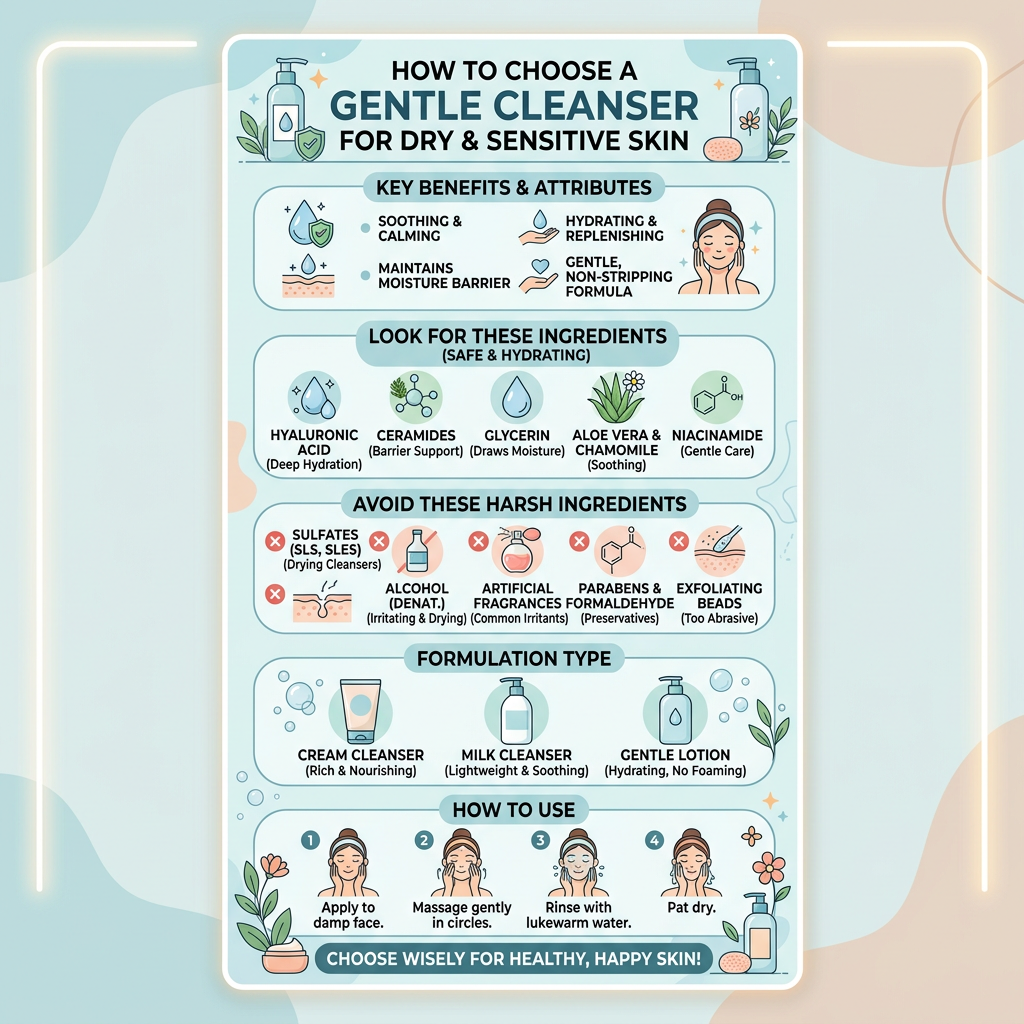
What to Look for in a Facial Cleanser
When choosing a gentle facial cleanser, start with what the formula avoids as much as what it includes.
Prioritize these features:
- Fragrance-free formula, especially if your skin burns, flushes, or reacts easily
- Non-exfoliating daily use formula
- Cream, lotion, milk, or gentle gel texture
- Minimal “squeaky clean” feel after rinsing
- Humectants such as glycerin
- Barrier-supportive ingredients such as ceramides, fatty alcohols, or similar moisturizing components
- Clear directions for use on sensitive skin
Be cautious with:
- Strong fragrance or essential oils
- Scrub particles
- High-strength acids in a daily cleanser
- Sulfate-heavy or very foamy formulas if your skin is already dry
- “Deep clean” or “purifying” positioning unless your skin clearly needs that
A cleanser is doing its job if your face feels comfortable afterward. Tightness, itching, hotness, or visible redness right after washing are signs the formula may be too harsh, even if the brand markets it as gentle.
Ingredients That Often Help Dry, Sensitive Skin
You do not need a long ingredient list, but some ingredients are commonly associated with a more supportive cleansing experience.
Often helpful:
- Glycerin
- Ceramides
- Hyaluronic acid
- Squalane
- Colloidal oatmeal
- Panthenol
- Niacinamide, if well tolerated
- Fatty alcohols that support texture and softness
These ingredients do not guarantee a perfect cleanser, but they can be positive signs when combined with a mild overall formula.
Ingredients and Claims to Approach Carefully
Dry, sensitive skin buyers are often targeted with soothing claims that can be misleading without context.
Watch for these issues:
- “Natural” does not automatically mean gentler
- Essential oils can smell pleasant but still irritate sensitive skin
- Botanical-heavy formulas may increase reaction risk for some users
- “Dermatologist tested” does not tell you how many people were involved, under what conditions, or how the product compared with alternatives
- “For sensitive skin” is helpful only if the formula actually avoids common triggers
Also remember that ingredient-level popularity is not proof. A cleanser containing a trendy soothing ingredient can still be too harsh overall if the surfactants, fragrance, or exfoliants are not suitable.
Best Choices for Different Buyers
Best for most people with dry and sensitive skin:
- Cream cleanser
Best for very dry, flaky, or overtreated skin:
- Lotion cleanser
Best if you want a rinse-clean feel without giving up gentleness:
- Gentle gel cleanser
Best for highly reactive skin that hates strong cleansing:
- Milk cleanser
Best for convenience or morning cleansing:
- Micellar cleanser
Best for makeup and water-resistant sunscreen removal:
- Cleansing balm
Best for double-cleansing routines:
- Oil cleanser followed by a gentle cream or gel cleanser
Usually the riskiest picks for this skin type:
- Foaming cleanser
- Exfoliating cleanser
Important Limitations and Buying Risks
The biggest buying mistake is choosing based on marketing language instead of formula profile. Terms like “clean,” “refreshing,” “purifying,” and even “sensitive” can mean very different things from one brand to another.
Other practical risks include:
- Buying a cleanser that is too weak for your sunscreen or makeup, then compensating by rubbing harder
- Buying a cleanser that is too strong, then needing extra moisturizers just to recover from washing
- Confusing dehydration, irritation, and dryness; all three can make skin feel uncomfortable, but a harsher cleanser usually makes them worse
- Ignoring seasonal changes; a cleanser that feels fine in summer may become too stripping in winter
- Using very hot water, long cleansing times, or repeated washing, which can make even a good gentle facial cleanser feel harsher
A cheaper simple cleanser may be more appropriate than a premium one packed with actives. For dry and sensitive skin, cleanser performance often comes down to mildness and compatibility, not complexity.
If your skin is persistently inflamed, cracked, or burning, a different product type may not be enough on its own. In those cases, a simpler routine and professional medical advice may be more useful than continuing to experiment with trend-driven cleansers.
Final Verdict
For most buyers searching for a facial cleanser for dry and sensitive skin, a cream cleanser is the best overall choice because it offers the most reliable balance of gentleness, comfort, and everyday practicality. It is usually the safest place to start if your current cleanser leaves your skin tight or irritated.
The strongest alternative is a lotion cleanser for very dry or compromised skin, especially when barrier comfort matters more than cleansing power. A gentle gel cleanser is the better pick for buyers who want a fresher rinse-clean feel or need somewhat stronger daily cleansing for sunscreen.
The biggest uncertainty is that cleanser categories are only starting points. Individual formulas within the same type can differ a lot in fragrance, surfactants, and added actives. The smartest buying decision is to choose the right cleanser type first, then confirm that the specific formula avoids your known triggers.
Research Disclosure
This article is a documentation-based editorial comparison unless explicitly stated otherwise.
Olive Branch did not conduct independent hands-on or laboratory testing for this article.
Manufacturer claims should be treated as official statements rather than independent confirmation.
Prices, availability, formulas, specifications, and product generations may change.
Readers should confirm current details before purchasing.
Sources and Verification
Source links require editorial verification before publication.
Last Verified
Last verified: August 7, 2026.
Leave a Reply